
Hickman Parole and Probation
Tennessee splits the work between two agencies. The Tennessee Board of Parole decides whether parole should be granted. The Tennessee Department of Correction, or TDOC, supervises both parolees and probationers through Community Supervision. Parole is a conditional community release before a prison sentence ends. Probation is ordered by a court and may follow split confinement or take the place of a prison term. In either case, the person lives outside prison while remaining bound by a judgment, release plan, and assigned conditions.
A Board grant is one step, not the gate event. TDOC may still need an approved release plan and other pre-release work. A probation order also has its own reporting instructions. TDOC states that a probationer must generally report within 48 hours of placement or release from split confinement, while a local conditions form has used 72 hours. The signed judgment and instructions control for that person. Do not replace them with a general deadline.
| Point | Parole | Probation |
|---|---|---|
| Who authorizes it | Tennessee Board of Parole | Sentencing court |
| Custody link | Conditional release from a prison sentence | Court supervision, sometimes after split confinement |
| Public verification | FOIL status, Board result, TDOC release record | FOIL when TDOC tracks it, plus the court order |
| Who supervises | TDOC Community Supervision | TDOC Community Supervision for state cases |
| How it ends | Discharge or sentence completion shown by an official record | Court or TDOC discharge under the controlling order |
- Parole
- Conditional community release before the sentence expires.
- Probation
- Court-ordered supervision in the community.
- Discharge
- The formal end of custody or supervision documented by the responsible agency or court.
- Absconder
- A person alleged to have stopped reporting or left supervision without authorization. The label must come from an official source.
Verify Hickman Post-Release Supervision
The public person-level starting point is TDOC Felony Offender Information Lookup, known as FOIL. It covers felony offenders currently or formerly in TDOC custody or supervision. Search with a TDOC ID or State ID Number when possible. A name search can include aliases, but a similar name or photo is not enough. Match the date of birth and agency identifiers before reading the supervision result.
FOIL can show “Parole,” “Probation,” or “Inactive.” Parole or probation supports that the person is outside prison and under TDOC supervision. Inactive may fit a former TDOC case, but it is not the same as a discharge certificate. The assigned location can help route a call. A person who served only a local misdemeanor or short Hickman County Jail term may not be in FOIL at all. For that case, use the Hickman court judgment and the agency named in the order.
- Open FOIL and search by TDOC ID, SID, or a carefully matched name.
- Match the date of birth, identifier, aliases, and assigned location.
- Read Current Status and Supervision Status before relying on any date.
- Use the current TDOC field-office directory to identify a likely contact.
- Call the office and confirm that it serves the Hickman County assignment before relying on the address.
- For final discharge, request the TDOC discharge record or the controlling court order.
Note: No FOIL match is not proof that supervision ended; local-only cases and indexing differences can produce no result.
Hickman Supervision Office Lead
Statewide materials associate Hickman County with the Columbia and District 51 supervision geography. However, the current directory does not cleanly name Hickman in that office heading. Treat Columbia as a contact lead to confirm, not as a fixed assignment. Call first, give the person's TDOC number if known, and ask which current field office holds the case. Staff may limit what they can disclose, but they can route a valid supervision question.
Possible Columbia Contact
TDOC Community Supervision
2506 Pillow Drive
Columbia, TN 38401
931-982-1398
Service-area status: Confirm through the current field-office directory before visiting or mailing records.
The official directory page is the source to check for assignment changes. It is also the source for the image below.
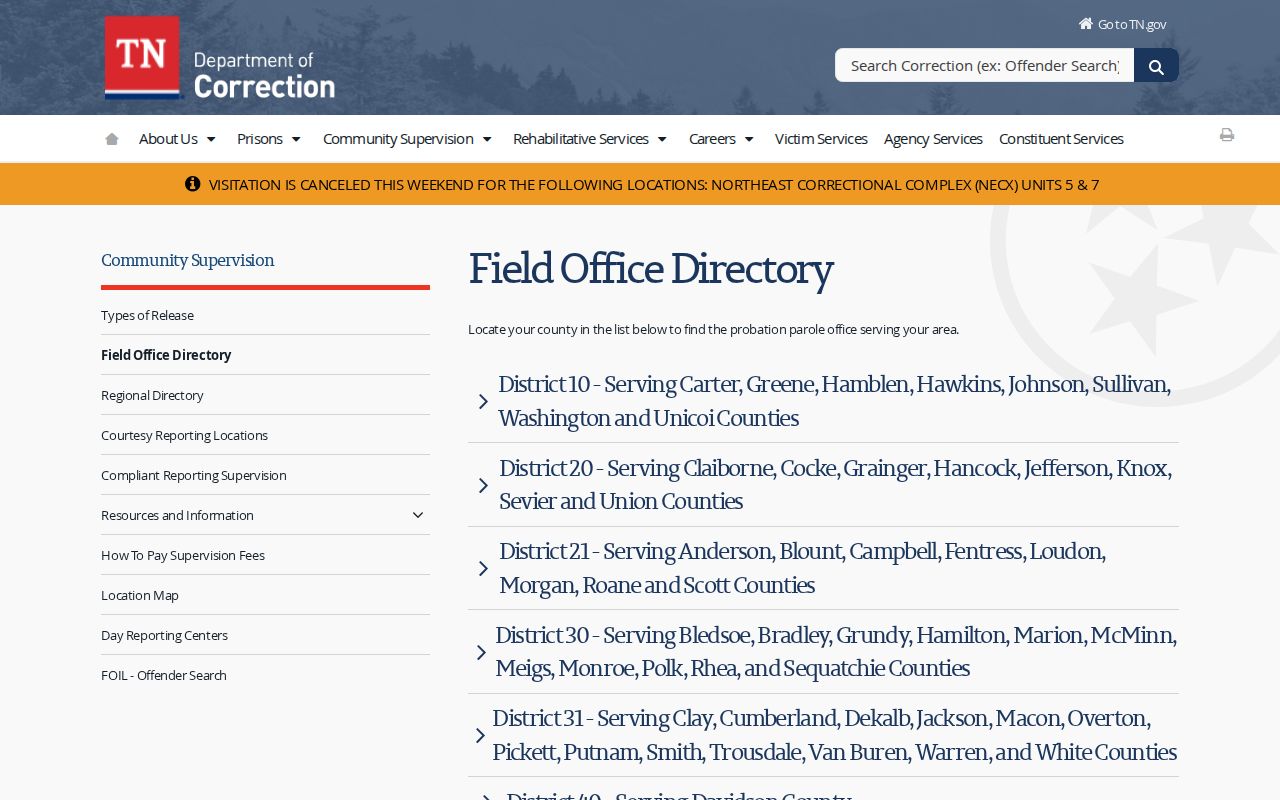
The directory should be used with FOIL's Assigned Location field, then confirmed by phone because office boundaries and case assignments may change.
Hickman Parole Hearing Record
A Hickman County or Turney Center case may have a hearing before the Board. The official hearing-schedule procedure says schedules update weekly on Monday, or Tuesday after a Monday holiday, and cover the next four weeks. The current route is to request a schedule from BD.HearingSchedules@tn.gov or verify through the Parole Hearings Division at 615-741-1150. Schedules can change at short notice.
Hearing officers make nonbinding recommendations. Board members may adopt, change, or reject them. FOIL's Parole Hearing Result is the verified public person-level result path because no standalone statewide decisions database was found. A grant still does not prove physical release. Programs, a release plan, and TDOC authorization can remain pending. A revocation hearing is different: it addresses claimed violations after parole, and the final result may revoke or reinstate supervision.
The hearing type changes the meaning of the result. A grant hearing considers release on parole. A custodial hearing considers parole from one sentence to another, so it may not lead to the community at all. Preliminary and final revocation hearings address alleged violations. Rescission can undo a grant when conduct or material information changes before or after parole. A time-setting hearing decides when a new felony sentence starts for a person already on parole.
An appeal is limited. Tennessee materials allow a request based on significant new information, substantiated misconduct by a hearing official, or a significant procedural error. Tenn. Code Ann. § 40-28-105(d)(11) sets a 45-day request period after the offender receives a final denial, revocation, or rescission decision. That process reviews the Board action. It does not replace TDOC's records of later release, supervision, or discharge.
The Board describes its current schedule route on the weekly schedule page.
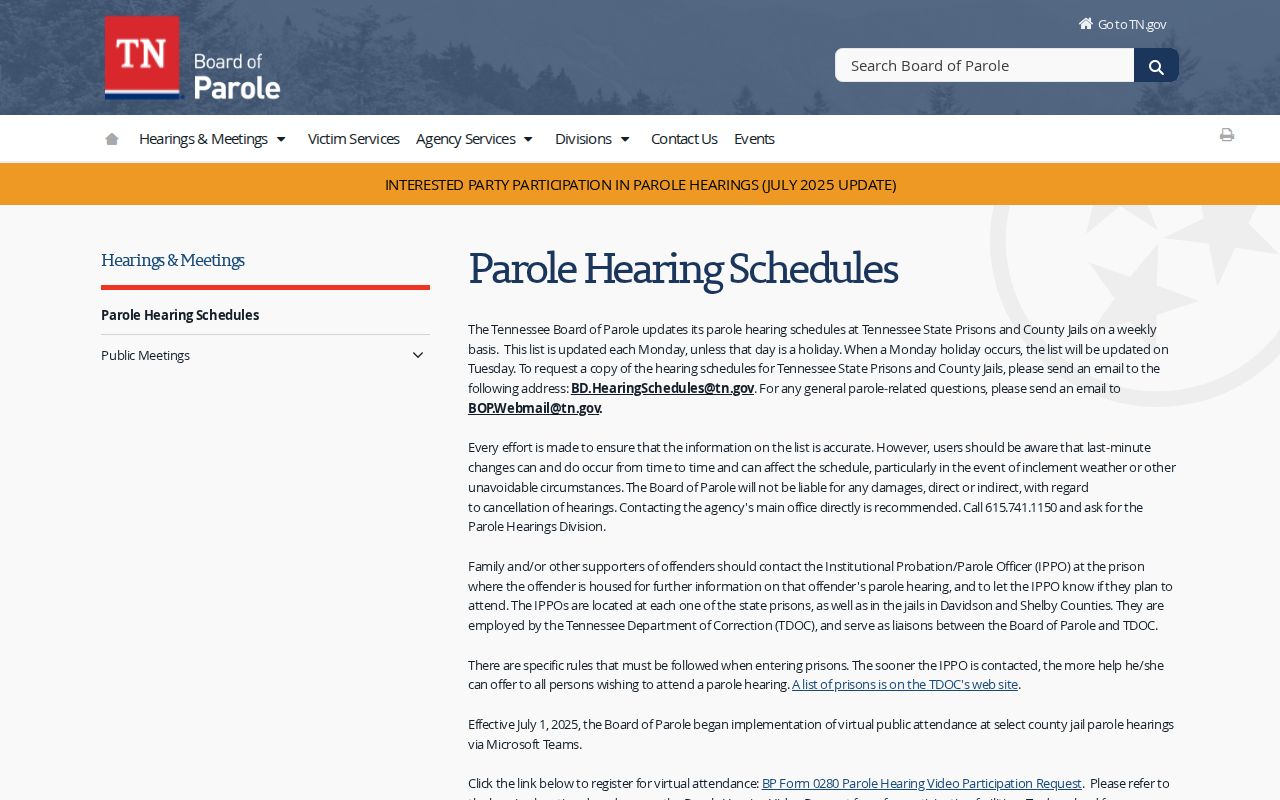
This schedule supports hearing timing. It does not replace FOIL's result field or TDOC's actual release authorization.
Hickman Supervision Status Changes
Conditions depend on the judgment and release plan. Common categories can include reporting, approved residence, treatment or programs, and compliance with court orders. A violation allegation does not by itself prove revocation. Preliminary and final proceedings may be required, and the official order or Board result shows the outcome. Tennessee SAVIN through VINELink can send custody events, but it is not a complete supervision-history file or a universal warrant search.
The TBI Sex Offender Registry may identify a wanted registry violator, yet it applies only to people with a qualifying registration duty. It is not a general parole or probation database. For a claimed absconder or warrant, use FOIL to identify the supervising office, ask that office which custodian can verify the status, and obtain the actual order when a court or Board acted. A name's disappearance from FOIL does not prove discharge.
Other Tennessee categories also matter. Determinate release is a special probation category for some qualifying felony sentences. Mandatory reentry supervision can apply to qualifying felony offenses under Tenn. Code Ann. § 40-35-506. Community Supervision for Life applies only to specified offenses under § 39-13-524. Each term must be read from the person's record, not guessed from a release date.
Determinate release can apply to qualifying one-to-two-year felony sentences after at least 30 percent is served, subject to Tenn. Code Ann. § 40-35-501 and the objection process. Mandatory reentry supervision can place the last part of a qualifying term in the community or add a supervision period after expiration, depending on the statute. These categories explain why “sentence end” and “off supervision” may not be the same date.
TCIX and Hickman Reentry
Turney Center Industrial Complex creates a county-specific split in release searches. TCIX is a TDOC state prison in Hickman County, not part of Hickman County Jail. Its official TDOC profile lists education, cognitive and therapy programs, workforce development, college and technical partnerships, industry, and service-animal training. Those programs may form part of a prison or transition plan, but participation does not establish release or discharge.
A person leaving TCIX belongs in FOIL, TDOC release records, Tennessee SAVIN, and Community Supervision when paroled. An ordinary local jail case begins with the Hickman sheriff and court instead. The distinction prevents a common error: a transfer from TCIX to another TDOC institution is continued incarceration, while a nonincarcerated FOIL status paired with an actual authorization can support community release. State Community Resource Centers offer another navigation channel after release.
Hickman County release and records paths for local custody are set out on the released-inmate search home page. Use it when the custody episode never entered TDOC.
Property Receipt After Hickman Release
A signed property receipt can corroborate a physical release from Hickman County Jail. The CTAS sheriff records schedule describes an itemized property and cash return receipt signed by the released person and witnessed by the releasing officer. The model schedule recommends permanent retention. That makes the receipt useful when a live roster no longer shows the person or when returned property is disputed.
The receipt proves only its own event. It does not show that a charge was dismissed, that probation ended, or that a sentence was fully discharged. Pair it with the jail register, release order, movement log, or court judgment. For a TDOC release, the CR-1947 authorization and TDOC release checklist are the stronger records. A property receipt from the county jail should not be used to infer what happened in a later prison or supervision case.
Supervision ends through a formal discharge, sentence completion, or controlling court action. Request that record from TDOC or the court rather than relying on an absent web result. A complete trail separates the Board decision, physical gate event, community supervision, and final discharge.
For a court-ordered probation case, ask the Hickman Circuit Court Clerk to identify the court file and provide the judgment, probation order, amendments, revocation orders, and any order ending supervision. For a TDOC case, request the discharge or archived supervision record. FOIL is a useful public summary, but the originating order answers the final legal question.